
Cataract Surgery - Phacoemulsification
Stitchless, micro-incision phacoemulsification cataract surgery with premium monofocal, toric, and multifocal/EDOF IOL implantation in Agartala.
Duration
10 - 15 Minutes
Anesthesia
Topical Eye Drops (100% Needle-Free & Sutureless)
Hospital Stay
Day-Care Outpatient (Discharge in 2 Hours)
Recovery
Resume reading & light work in 24 - 48 hours
Clinical Overview & Treatment Method
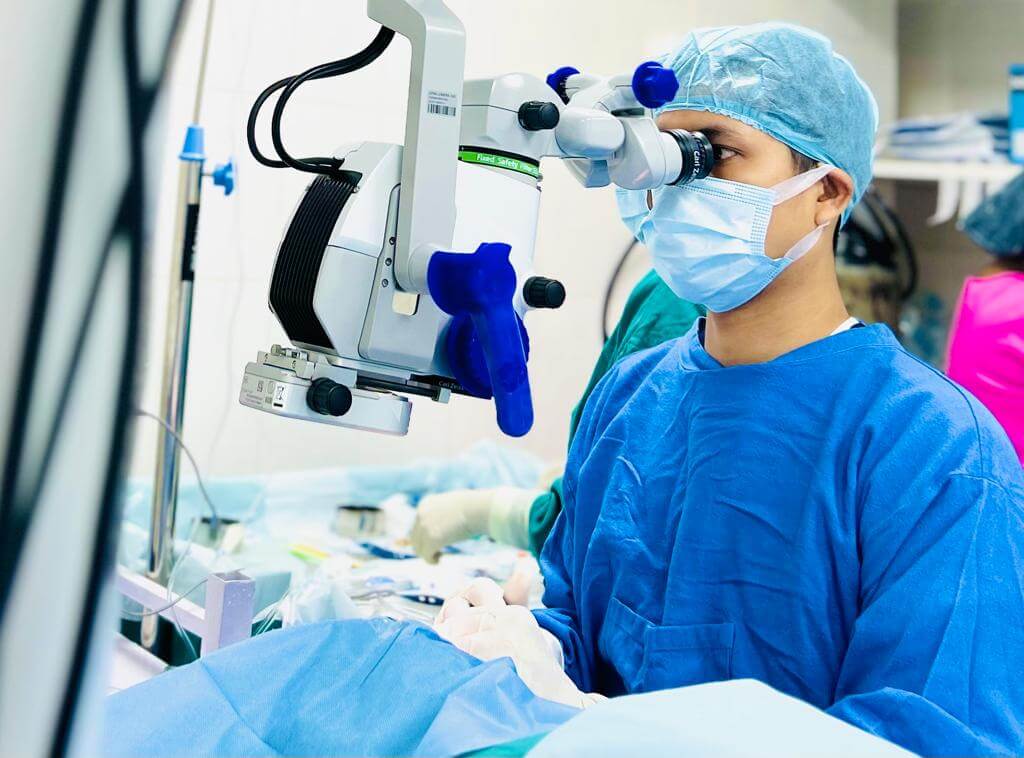
Ashvini Netralaya is Tripura’s highest-rated superspeciality center for Micro-Incision Cataract Surgery (MICS/Phacoemulsification). Utilizing the state-of-the-art Alcon Centurion® Vision System and Carl Zeiss Lumera® surgical stereomicroscopes, our fellowship-trained cataract surgeons remove clouded natural lenses through a self-sealing 1.8mm to 2.2mm micro-incision. The surgery is performed entirely under topical anesthetic eye drops—meaning zero needles, zero stitches, zero eye patches, and zero post-operative pain. Patients regain crystal-clear, vibrant vision and are comfortably discharged within two hours of surgery.
With over 10,000 successful cataract operations performed, our surgical team offers Tripura's widest selection of advanced intraocular lenses (IOLs), including wavefront-optimized aspheric monofocals, toric lenses for high corneal astigmatism, and multifocal/extended depth of focus (EDOF) implants that restore crisp reading and driving sight without glasses.
Key Clinical Advantages at Ashvini Netralaya
Symptoms & When to Consult an Eye Specialist
If you or your family members in Agartala or Tripura experience any of the following indications, we strongly advise scheduling an evaluation:
Who is an Ideal Candidate for this Procedure?
Intraocular Lens (IOL) Options at Ashvini Netralaya
We offer all internationally approved premium intraocular lenses. Your surgeon will recommend the ideal match based on your lifestyle, visual demands, and ocular biometry.
| Option / Type | Vision Range | Night Glare | Spectacle Freedom | Ideal Candidate |
|---|---|---|---|---|
Standard Monofocal IOL Standard Coverage | Clear Distance Vision | Minimal / None | Requires glasses for reading & computer | Patients comfortable wearing reading glasses for close work |
Toric Astigmatism IOL Astigmatism Specialist | Distance Vision + Astigmatism Correction | Minimal / None | Sharp distance vision without cylindrical glasses | Patients with pre-existing corneal astigmatism (> 0.75 D) |
Multifocal / Trifocal IOL Most Popular Premium | Distance, Intermediate (Computer), and Reading (Near) | Mild temporary halo rings around headlights | 85% - 95% complete spectacle independence | Active adults who want to read, drive, and use laptops glasses-free |
Extended Depth of Focus (EDOF) Cutting Edge | Continuous Distance through Intermediate & Arm's Length | Virtually indistinguishable from monofocal (negligible halos) | Spectacle-free for driving, computers, cooking & dashboard | Frequent night drivers and professional computer users |
Step-by-Step Procedure at Ashvini Netralaya
Conducted in our modular NABH-accredited operating theatres or diagnostic laboratories with zero-infection sterilization protocols.
Optical Biometry & Lens Power Calculation
15 mins (Pre-op)Advanced non-contact laser biometry calculates corneal curvature and axial length down to the micron to customize your exact intraocular lens power.
Topical Drop Anesthesia
5 minsSpecialized anesthetic drops numb the ocular surface completely. No needles, retrobulbar blocks, or painful facial injections are required.
Micro-Incision & Continuous Curvilinear Capsulorhexis
3 minsA microscopic 2.0mm self-sealing tunnel is fashioned in the clear cornea, and a circular opening is created in the anterior lens capsule.
Ultrasonic Phacoemulsification
4 minsHigh-frequency ultrasonic waves gently liquefy and emulsify the cataractous lens into microscopic particles, which are aspirated through an irrigation-aspiration port.
Foldable Intraocular Lens (IOL) Implantation
3 minsThe customized foldable lens is injected through the micro-incision directly into the natural capsular bag, unfolding smoothly into permanent alignment.
Recovery Timeline & Visual Milestones
Day-Care Discharge & Initial Rest
Rest comfortably at home. Vision will start clearing within 3-4 hours as pupil dilation wears off. Avoid touching the eye.
- Rest in comfortable room
- Take prescribed antibiotics & anti-inflammatory eye drops
- Watch TV or listen to audio at moderate volume
OPD Slit-Lamp Review
Surgeon confirms clear cornea, well-centered IOL, and normal intraocular pressure. Visual acuity typically reaches 6/6 to 6/9.
- Normal walking and eating
- Light reading and mobile phone use
- Avoid washing eye with tap water directly
Visual Stabilization & Routine Activity
Corneal micro-incision is completely sealed. Inflammation settles significantly. Patients resume desk jobs and driving.
- Resume office work & computer tasks
- Outdoor walking with UV sunglasses
- Discontinue nighttime eye shield after doctor confirmation
Complete Visual Rehabilitation
Full healing achieved. Final refraction test given for reading glasses if a monofocal IOL was implanted.
- Resume swimming and gym workouts
- No restrictions on travel or daily living
- Lifelong crystal-clear vision secured
Pre-Procedure Preparation
- •Instill the prescribed antibiotic eye drops starting 1 day before surgery as directed.
- •Have a light meal 2 to 3 hours prior to scheduled surgery time.
- •Take your routine blood pressure or thyroid medications on schedule with small sips of water.
- •Arrange for an accompanying family member to escort you home after day-care discharge.
- •Avoid wearing facial makeup, perfume, hair cream, or jewellery on the day of surgery.
Post-Procedure Guidelines
- •Wash your hands thoroughly with soap before instilling any eye drops.
- •Do NOT rub, squeeze, or apply direct pressure to the operated eye.
- •Avoid splashing tap water directly into the operated eye for 10-14 days.
- •Wear the transparent protective eye shield while sleeping during the first week.
- •Avoid heavy weight-lifting (> 10 kg), bending deeply from the waist, or straining.
Precision Equipment & Technological Advantage
Centurion® Vision System
Alcon Laboratories (USA)Active Sentry® fluidics monitors intraocular pressure continuously during surgery, maintaining a rock-steady anterior chamber for maximal corneal endothelial protection.
OPMI Lumera® 700 Microscope
Carl Zeiss Meditec (Germany)Patented Stereo Coaxial Illumination (SCI) provides brilliant red reflex, enabling sub-millimeter precision during capsulorhexis and lens alignment.
IOLMaster® 500 / 700
Carl Zeiss Meditec (Germany)Gold standard swept-source optical coherence biometry ensuring exact IOL power calculation, virtually eliminating refractive surprises.
“I was terrified of having surgery on my only seeing eye. Dr. Anurag and the surgical team at Ashvini Netralaya treated me with so much warmth. The surgery took only 12 minutes, no injection at all! The very next day my vision was completely bright and colorful. Truly a five-star hospital in Agartala.”
Frequently Asked Questions About Cataract Surgery - Phacoemulsification
Is Phaco cataract surgery painful?
What is the difference between Monofocal and Multifocal lenses?
How soon after surgery can I resume my office work or household chores?
Is cataract surgery covered under cashless health insurance?
Can both eyes be operated on the same day?
Can a cataract return after surgery?
Schedule Your Consultation
Direct access to Ashvini Netralaya’s specialist ophthalmology team in Agartala.
Dr. Anurag Majumdar
MBBS, MS (Ophthalmology) | Medical Director & Senior Phaco Surgeon
OPD Consultation Hours
Mon - Sat: 9:00 AM - 7:00 PM
Emergency Eye Trauma: 24/7
📍 Bijoykumar Chowmuhani, Opposite Eastern Scientific Corporation, Krishna Nagar, Agartala, Tripura - 799001
Other Specialities at Ashvini Netralaya
Vitreo-Retina Surgeries & Medical Retina
Advanced 25G/27G sutureless vitrectomy, retinal detachment repair, diabetic retinopathy laser & anti-VEGF injections in Agartala.
Paediatric Ophthalmology & Squint Care
Compassionate child vision screenings, amblyopia (lazy eye) therapy, squint surgery, and pediatric refraction in Agartala.
Comprehensive Eye Checkup & Vision Assessment
Complete 7-point ophthalmic examination including dilated fundus, computerised refraction, slit-lamp biomicroscopy & eye pressure test.